HSL at Posidonia 2026, Athens
The HSL team will be in Athens this June for Posidonia 2026 and is open to meetings arranged ahead of the event.
READ ARTICLE →
HSL delivers crane solutions for vessels, shipyards, ports, offshore platforms and wind farms — from specification and supply through installation, commissioning, service and spare parts.
HSL manages the crane through its full lifecycle, so performance is accountable to one partner long after handover.
Match load, radius and operating conditions to the right configuration.
Manufacturing oversight, shipping and commissioning on site.
Inspection, planned maintenance and technical support.
Spare parts kept inventory available for equipment in service.
Yard lifting, deck cranes and ship system equipment.
VIEW SECTOR →Bulk, container and floating transshipment handling.
VIEW SECTOR →Oil platform cranes and support vessel lifting.
VIEW SECTOR →Installation cranes, jackets and installation vessels.
VIEW SECTOR →Our crane solutions are designed and certified to comply with major international classification societies and regional safety standards.
Market analysis, sector research and company updates from the HSL team.
The HSL team will be in Athens this June for Posidonia 2026 and is open to meetings arranged ahead of the event.
READ ARTICLE →Subsidy mechanisms are stabilising and tender rounds are getting larger. A market by market read of where the 2026 opportunities actually sit.
READ ARTICLE →Platforms, support vessels and the new generation of wind installation assets, set out in one place with what each type is actually for.
READ ARTICLE →Lifting equipment for marine, port and offshore operations — specified, supplied, installed and supported.
Yard lifting, deck cranes and ship system equipment.
VIEW SECTOR →Bulk, container and floating transshipment handling.
VIEW SECTOR →Oil platform cranes and support vessel lifting.
VIEW SECTOR →Installation cranes, jackets and installation vessels.
VIEW SECTOR →Send us your load, radius and operating conditions — we'll come back with options.
Lifting and deck equipment for shipyards and newbuild vessels — from block assembly in the yard to the machinery working on deck.
Rail-mounted gantry cranes for block assembly and section handling in the building dock.
Folding boom for controlled deck handling, ship-to-ship transfer and subsea work.
Boom & duty type Drive typeAnchor windlasses for chain handling and anchor recovery.
Didn't find what you were looking for? We provide fully customised solutions.
Cranes and handling equipment for bulk cargo, container terminals and floating transshipment.
Portal jib cranes in double-link and single-jib configurations, working with hook, grab or container spreader.
Quayside container cranes sized to vessel beam and berth outreach.
Floating cranes for bulk cargo transfer between vessels at anchorage.
Send throughput requirements and targets — we'll propose equipment options.
Oil platform cranes and support vessel lifting equipment, built for continuous duty in demanding offshore conditions.
General-purpose platform cranes for supply handling and deck operations, configurable to API-2C on request.
AHC cranes for precise subsea and ship-to-ship lifting from semi-submersibles, pipelaying vessels, diving support and research vessels.
Send the deck layout and duty requirement and we'll match a crane configuration.
The widest scope of our four sectors — installation cranes, heavy-lift floating cranes, turbine foundations and installation vessels.
Heavy-lift cranes for jack-up and installation vessels, sized for current-generation turbines and foundations.
Tell us which you're exploring — you'll be talking to us directly, from first enquiry through delivery.
Our role is not simply to supply equipment. We source, evaluate and qualify the right manufacturing solution for each project, then take ownership of compliance, project management and long-term after-sales as the client's single point of accountability.
That means one partner from technical selection through production oversight, delivery and commissioning, and on into spare parts supply for the full working life of the equipment — no fragmented supply chain, no coordination gaps.
Established supply chain resources allow us to deliver internationally certified equipment at a competitive total cost of ownership.
A dedicated technical team manages specification, design review and third-party certification end to end.
Compliance is engineered in from day one, not retrofitted — class approval, CE marking and the directives of each destination market as standard.
After-sales support runs for the full operational life of the equipment, covering both service and parts availability. Downtime is scheduled in advance.
Our values reflect what we want our clients, partners and colleagues to experience whenever they deal with HSL.
Our footprint is deliberately split: operations sit alongside manufacturing so quality can be controlled in person, while contracting and client relationships are run from Hong Kong to serve clients in any market.
Group headquarters — commercial leadership, contracting and client relationships.
Partnered OEM production base for cranes and offshore wind products, with technical selection and production oversight on the ground.
Port, marine, shipbuilding, offshore and offshore wind clients.
Tell us about your project — you'll be dealing with the same team from first enquiry through delivery.
A crane is only as good as the support behind it. HSL combines engineering response with a multi-brand parts supply chain, so equipment stays in service wherever it operates.
Technical response scaled to the problem. Most questions are resolved remotely; when they aren't, our engineers attend site.
Multi-brand sourcing means we are not limited to the equipment we supplied, and compliance requirements are met per market.
Fault diagnosis, operating guidance and engineering advice from the team that specified the equipment.
Components sourced across manufacturers, for equipment of any make.
Engineers deployed to site where the situation requires hands on the machine.
Parts supplied with the certification your operation and jurisdiction require.
Scheduled inspection and servicing matched to duty cycle, so wear is caught before it becomes downtime.
Under an annual agreement, routine replacement parts ship to site on a planned cycle rather than on request.
Response to breakdowns and damage, coordinated through a single point of contact at HSL.
Wire rope, rigging and wear parts held against your specific configuration.
Our service network is expanding with the projects we deliver. We build capability where our clients operate — combining our own engineering team with qualified local partners engaged at project stage, before the equipment arrives.
Coordination always stays with HSL. Whoever attends site, you deal with the same team from first enquiry through the working life of the equipment.
We support cranes we supplied and equipment from other manufacturers — tell us what you're running.
Wire rope, rigging, protective equipment and crane spares — held in stock or sourced through a long-standing supply chain, for equipment of any make.
Wire rope is the fastest-wearing part of a crane and the one most often left to a third party. HSL operates its own processing facility, so replacement assemblies are made up to specification rather than sourced and waited on.
Our facility runs authentic TALURIT® hydraulic swaging machines at 250 t and 1000 t. As the global pioneer in wire rope mechanical splicing, TALURIT® technology gives consistent, accurate pressure distribution on every splice — with the 1000 t press handling large-diameter rope for the most demanding lifting duties. Using original TALURIT® systems means zero slippage and 100% of the rope's rated efficiency retained.
Dedicated rope and rigging processing floor.
Every termination meets EN 13411-3 and other international safety standards.
High-strength marine and crane ropes certified by leading classification societies, in compacted and plastic-impregnated constructions.
As a multi-brand agent we are not limited to what we supplied — parts can be sourced for equipment from other manufacturers.
Long-standing manufacturer relationships mean consistent availability rather than one-off sourcing.
Tell us specification and quantity — we confirm what is available now and lead time on the rest.
Rope and rigging supplied with classification society certification where the application requires it.
Send specification and quantity — we'll confirm availability and price.
Send us the requirement and you'll be dealing with the same team from first enquiry through to delivery and service.
Mon – Fri, 09:00 – 18:00 (GMT+8)
We respond within 24 business hours.
Room 517, 2 Lei Yue Mun Road, Kwun Tong, Hong Kong
No. 696 Weihai Road, Jing'an District, Shanghai, China
The same team handles specification, supply, commissioning and after-sales — no handovers between departments.
Enquiries are answered by people who can discuss load, radius and duty cycle in detail.
Class approval, CE marking and the certification your operation and jurisdiction require.
Multi-brand parts supply and engineering response for the working life of the equipment.
Market analysis, sector research and company updates from the HSL team.
Send us the operating conditions and we will come back with an assessment rather than a brochure.
The HSL team will be attending Posidonia 2026 in Athens this June, and we would be glad to meet clients, partners and colleagues in person while we are there.
Posidonia brings the shipping and offshore community together in one place, which makes it a practical setting for the kind of conversation that is difficult to have by email. Whether it is a short catch up or a longer technical discussion about a lifting requirement or an offshore wind package, we would rather have it face to face.
Slots fill up quickly during the week of the show, so we suggest getting in touch in advance. Send us a note with the topic you would like to cover and a preferred day, and we will come back with a time.
See you in Athens.
2026 is a significant year for European offshore wind. The sector is moving toward stabilised subsidy mechanisms and large scale tender rounds, and for anyone working in the maritime and energy supply chains, understanding these regional shifts is now a planning requirement rather than a background interest.
The UK continues to lead on volume. Following the record setting AR7, the government has confirmed that Allocation Round 8 will open in July 2026. Projections suggest the combined capacity of AR7 and AR8 could exceed 20 GW.
Germany will not hold new auctions in 2026. The 2.5 GW auctions N-10.1 and N-10.2 have been rescheduled to 2027 while the legislative transition toward a Contract for Difference model is finalised. Immediate order windows are limited this year, and attention has shifted to the revision of the Offshore Wind Energy Act, which will set the growth path from 2027 onward.
In September 2026 the Netherlands will open the tender for the IJmuiden Ver Gamma-A site at 1 GW. This is a move away from the zero subsidy model and back toward government supported CfDs, with a price cap of 104 euro per MWh. The intent is to reduce developer risk and protect deliverability, and it serves as an entry point into the wider IJmuiden Ver development zone.
Following the approval of a 5 billion euro state aid package by the EU, Denmark is proceeding with 1.8 GW across the Hesselo and North Sea Mid sites. A defining feature of the Danish auctions is the weight given to non price criteria such as blade recyclability and social responsibility. Suppliers need to align their technical and ESG documentation with those requirements to stay competitive.
Following the Tonn Nua award, Ireland is progressing with the remaining South Coast DMAP sites. The market is smaller than its North Sea neighbours, but a transparent CfD framework and openness to international supply chains make it a consistent route for firms building a presence in the Irish Sea.
The 2026 landscape shows a clear move toward de-risking projects through CfD mechanisms, while at the same time raising the bar on sustainability and local content. Success in this cycle will depend on engaging with tender timelines early and understanding the specific regulatory requirements in each jurisdiction rather than treating Europe as a single market.
From deepwater oil and gas exploration to the expanding offshore wind industry, offshore vessels are the backbone of marine engineering. There are a lot of specialised types, and they are easier to understand when grouped by the job they do rather than by the order in which you happen to encounter them.
Fixed or semi-fixed bases for drilling, production and accommodation.
Highly manoeuvrable vessels, usually DP equipped, built around specific operational phases.
Purpose built vessels driving the renewable energy transition.
Each of these vessel types puts a different demand on its lifting equipment. An AHTS working anchors, a WTIV placing a nacelle at height, and an MPSV running an ROV over the side are three entirely different load cases. Getting the crane specification right starts with being clear about which of them you are actually equipping.
The global offshore market is no longer a single market. Regional investment patterns now tell a story of energy sovereignty, technological maturity and deliberate strategic pivots, and the differences between them are large enough to change how a supplier plans its year.
Looking at the investment picture from 2015 to 2026, the divergence between the major maritime economies is clear.
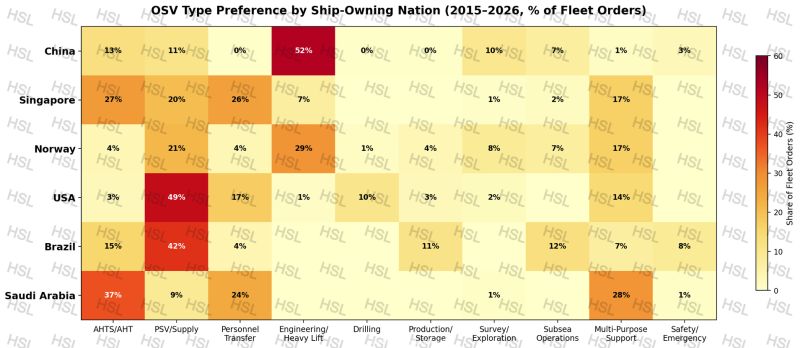
With a projected compound annual growth rate of 7.5 percent, the global offshore market is expected to pass 40 billion US dollars by 2030. The growth is fuelled by a structural supply shortage and by the dual engine of traditional energy and renewables pulling at the same time.
HSL works across this shift. Drawing on China's manufacturing cluster, we supply offshore vessel components and technical support so that owners can hold operational availability in a tightening market.
Is the offshore support vessel market at a turning point? After a brutal downturn we are seeing a structural recovery unlike any previous cycle. To understand where it goes next, it helps to be precise about how it got here.
The OSV market has always been a product of global energy demand, geopolitical shifts and capital expenditure cycles. Three decades break down into four clear eras.
Driven by shallow water projects in the North Sea and the Gulf of Mexico, the market operated on a build to order basis. With Brent hovering around 20 to 30 dollars per barrel, annual newbuild volume stayed modest, below 100 vessels.
Fuelled by China's industrialisation, a surge in energy demand pushed oil to 147 dollars per barrel in 2008 and set off an unprecedented shipbuilding race. Focus shifted to deepwater, producing a boom in high specification AHTS and PSV newbuilds, with annual deliveries peaking at 550 vessels in 2009. Speculative orders flooded in and set up the collapse that followed.
The US shale revolution broke the market. A sudden oil price crash forced seven years of balance sheet repair across the industry. High inventory and effectively zero orders led to widespread bankruptcies and fleet lay-ups.
Today's recovery is different. It is not driven by speculation but by two durable forces.
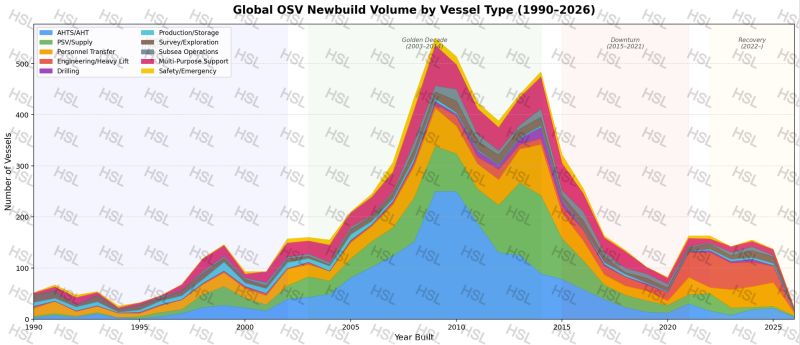
The practical implication for owners is that equipment availability and lead time now matter as much as price. A vessel that cannot be reactivated, or a crane package that cannot be delivered inside the window, is a lost trading year rather than a procurement inconvenience.
The epicentre of offshore shipbuilding has moved three times in eight decades. This is not simply a change in shipyard coordinates. It reflects how energy demand, technical complexity and supply chain efficiency have redefined the maritime industry, and understanding the trajectory matters for anyone managing global fleets and procurement today.
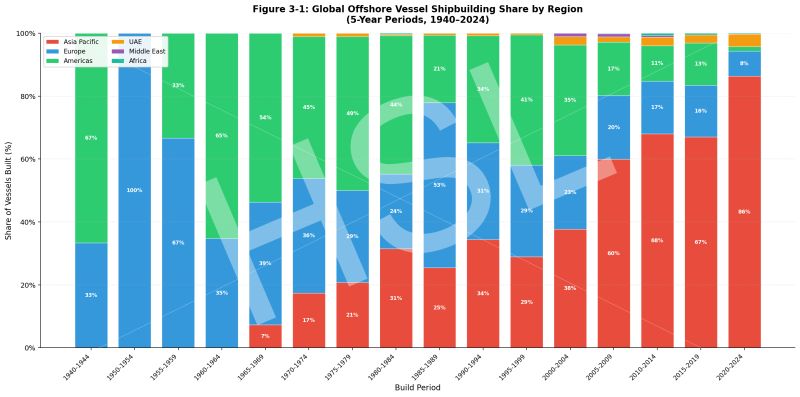
The modern offshore industry was born in the US Gulf of Mexico. In this era more than 70 percent of offshore vessels were built in US yards, and the period cemented what the industry still calls the American standard. American engine and deck equipment brands became the reference point. Even in 2026, a significant portion of the global vintage fleet still depends on that established US spare parts ecosystem.
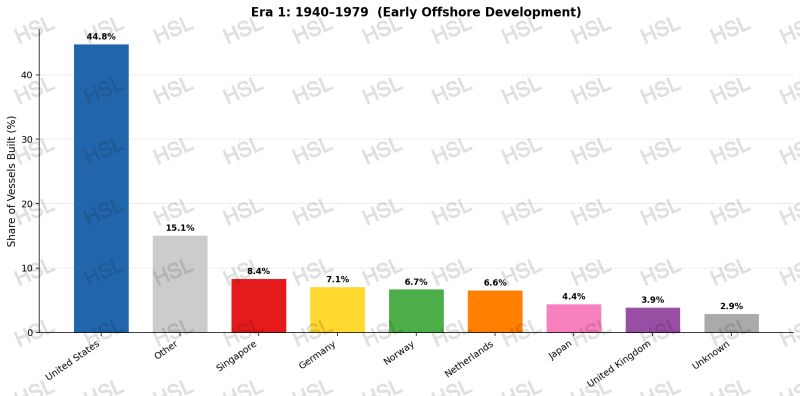
As exploration moved into the harsh, deep waters of the North Sea, yards in Norway, the Netherlands and the UK took the lead in high specification designs and dynamic positioning technology. At the same time Singapore and Japan emerged as dominant forces in specialised conversions and jack-up rigs. The era introduced a sophisticated European equipment layer into the global supply chain and raised the bar for vessel automation.
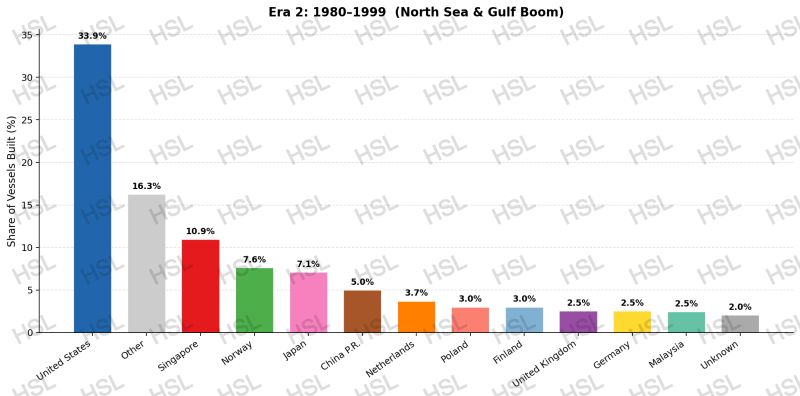
The centre of gravity has now settled firmly in East Asia. Driven by industrial infrastructure and a seamless steel supply chain, China, South Korea and Singapore together command more than 70 percent of global market share. Between 2010 and 2014 alone the region delivered over 1,500 vessels, a peak that reshaped the industry's logistics permanently.
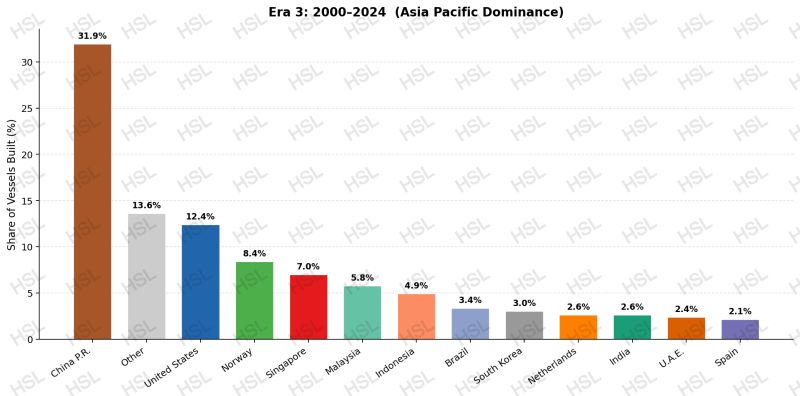
We are watching a profound maturation of the Chinese supply chain. It is no longer only about building the hull. Chinese manufactured marine components and lifting machinery are increasingly chosen by international shipowners for reliability, lead time and lifecycle cost.
HSL sits at the intersection of this shift. Working from China's manufacturing cluster, we supply offshore vessel parts, lifting equipment and technical support to a global client base, and we deal with both the legacy requirements of older fleets and the current needs of newbuilds.
How HSL Group (HK) Limited handles personal data collected through this website.
This website is operated by HSL Group (HK) Limited, a company registered in Hong Kong. For any question about personal data, write to info@hslholding.com.
Enquiry details are used to answer your enquiry and to carry on the commercial discussion that follows from it. We do not sell your data and we do not pass it to third parties for marketing.
Server logs are used for security, troubleshooting and aggregate traffic statistics. We do not use them to build a profile of you.
Where the EU or UK General Data Protection Regulation applies, we rely on the following grounds. For enquiry data, the steps taken at your request before entering into a contract, and our legitimate interest in responding to business enquiries. For server logs, our legitimate interest in operating a secure and reliable website.
The site is hosted on infrastructure operated by Amazon Web Services. Web fonts are loaded from Google Fonts, which means your IP address is transmitted to Google in order to deliver the font files. We do not use advertising trackers and we do not run third-party marketing pixels on this site.
Depending on where you are located you may have the right to ask for a copy of the personal data we hold about you, to have it corrected or deleted, to restrict or object to how we use it, and to receive it in a portable form. Write to info@hslholding.com and we will respond.
If you are in the EU or the UK and you believe we have not handled your data properly, you may also complain to your national data protection authority.
HSL Group (HK) Limited is based in Hong Kong and has operations in mainland China. Personal data you send us will be accessed from those locations. Where the GDPR applies, such transfers are made on the basis of appropriate safeguards.
Questions about this page can be sent to info@hslholding.com.
Last updated: September 2026
What this website stores on your device, and what it does not.
This website does not set any cookies. There is no advertising tracking, no analytics cookie and no social media pixel, which is why you are not being asked to accept a cookie banner.
If we later add analytics or any other service that sets cookies, this page will be updated first and, where the law requires it, you will be asked for consent before those cookies are set.
Questions about this page can be sent to info@hslholding.com.
Last updated: September 2026
The basis on which the information on this website is provided.
The content of this website is published for general information. It is not a quotation, an offer capable of acceptance, or a contractual commitment of any kind. A binding commitment arises only from a signed contract between HSL Group (HK) Limited and the counterparty.
Capacities, dimensions, working ranges and other technical figures shown on this site are indicative. Equipment is engineered to project requirements, and the governing figures for any supply are those in the approved technical specification for that project. Where a page states that a product is custom engineered, no standard figures should be assumed.
References to classification societies, CE marking and other standards describe the certifications to which equipment can be built and approved. Which certifications apply to a given supply depends on the scope, the jurisdiction and the intended service, and is confirmed in writing for each project.
Articles published under News and insights reflect our reading of the market at the time of writing. They are not investment advice and are not a forecast. Figures drawn from our internal database are presented as we hold them and may differ from other published sources.
Photographs illustrate equipment types and the sectors in which we work. Unless a caption states otherwise, they should not be read as depicting equipment supplied by HSL Group (HK) Limited on a specific project.
This site links to third-party platforms. We are not responsible for the content of those sites or for how they handle your data.
To the extent permitted by law, HSL Group (HK) Limited accepts no liability for loss arising from reliance on the content of this website. Nothing here limits liability that cannot be limited by law.
This disclaimer is governed by the laws of the Hong Kong Special Administrative Region.
Questions about this page can be sent to info@hslholding.com.
Last updated: September 2026